


Update from GM
 08-11-2009, 06:44 PM
#1
Burning Brakes

Thread Starter

Member Since: Mar 2005
Posts: 1,058
Likes: 0
Received 0 Likes
on
0 Posts
 Update from GM
8/11/09
Corvette: Production of the next-generation Corvette, internally called C7, is expected to start in April 2012 for the 2013 model year. The front-engine layout will be maintained.
Corvette: Production of the next-generation Corvette, internally called C7, is expected to start in April 2012 for the 2013 model year. The front-engine layout will be maintained.


 08-11-2009, 10:52 PM
#4
Drifting



http://www.autonews.com/article/2009...908119983/1259
An Automotive News article, you may need to be a subscriber to access it.
David
An Automotive News article, you may need to be a subscriber to access it.
David
 .
08-12-2009, 11:01 AM
.
08-12-2009, 11:01 AM
#6
Platinum Supporting Dealership
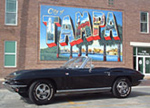
Here are some of the concept photos we've been collecting and a link to our C7 news archive:
http://www.corvetteblogger.com/index...1ECC1208911BEF
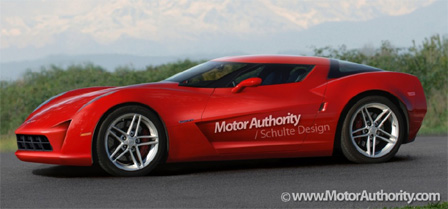
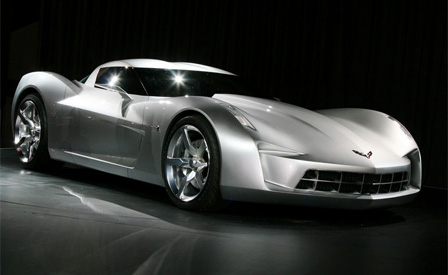
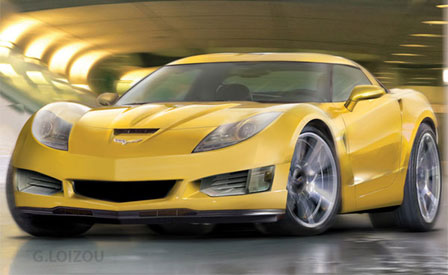

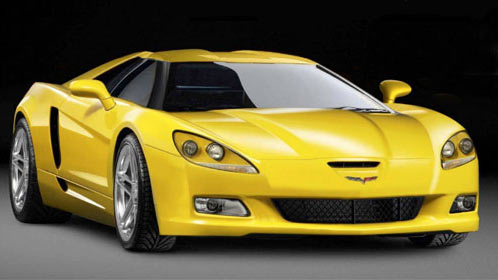

http://www.corvetteblogger.com/index...1ECC1208911BEF
__________________
'66 Conv. 327/300 - Original 1 owner.
Help us continue to support the forum by visiting VetteFinders.com
www.VetteFinders.com
Your Internet destination for buying and selling Corvettes.
Read My Corvette Blog
'66 Conv. 327/300 - Original 1 owner.
Help us continue to support the forum by visiting VetteFinders.com
www.VetteFinders.com
Your Internet destination for buying and selling Corvettes.
Read My Corvette Blog



 08-12-2009, 02:23 PM
#8
Melting Slicks



 08-12-2009, 04:34 PM
#10
Drifting

Above - This C6 pix first seen Nov 12, 2003 but said to have been taken July 23, 2003

Above - This was the first saw time we saw the entire body shape without camo, and also got a hint of a high performance model to come with the rear fender flares.
Do the math....

David
08-12-2009, 04:45 PM
#11
Advanced


Member Since: May 2008
Posts: 76
Likes: 0
Received 0 Likes
on
0 Posts
All that I have read (autoblog.com) indicate that the C7 will be smaller than the C6. All the concepts that we have pics of seem to be around the same size as the C6. It will be interesting to see what GM does with the smaller size and smaller engine.
- Shaun
- Shaun
08-12-2009, 06:07 PM
#12
Drifting

Member Since: Feb 2002
Location: Chapel Hill NC
Posts: 1,260
Likes: 0
Received 0 Likes
on
0 Posts
 Engine Size
The GT2 will be running a 5.5 ltr engine next year. With DFI, the power could be easily the same as current from an engine this size. With variable cam ala "99", it would have lots of punch.
The engineering is there.
The engineering is there.

 08-12-2009, 09:55 PM
#15
Drifting
 Right hand drive ?????
G'day,
Any word if RHD is planned for the C7? GM will be shooting itself in the foot if it does not look to satisfy this niche, but important market.
When General Motors Holden in Australia was considering introducing the Monaro, a two door version of the Holden Commodore four door sedan, the beancounters told the designers that they would have to sell 6,000 Monaros before a profit was made on them. They ended up selling about 50,000.
Then, when Pontiac wanted a Left Hand Drive version of the Monaro re-badged as a Pontiac GTO, the beancounters said that at least 2,000 LHD coupes would need to be sold before a profit was made. I believe that 30,000 GTOs were sent to the US and Canada.
I know a Monaro is a different car to a Corvette, but the firewall and dashboards of both are not too different from a function perspective.
So, the point is this: how many RHD Corvettes would Bowling Green have to make before they started to show a profit? Is 2,000 about right? If not, what IS the correct figure?
RHD Corvettes would have a ready world market in Great Britain, Ireland, Japan, India, Pakistan, Indonesia, South Africa, New Zealand and Australia, as well as several smaller countries where RHD is the norm.
At a time when the Corvette factory is closed Fridays, and making just over half the cars that they were building only a year or two ago, I just cannot understand why GM are not looking at every possible way to increase the output of Bowling Green. And RHD will increase sales.
Porsche, Ferrari, Audi, BMW, Volkswagen and EVERY other manufacturer in the world builds both LHD and RHD cars and trucks. Every company but Ford America and GM. Maybe that's why Toyota is now the #1 car manufacturer in the world. They listen to what the customer wants.
And this customer is telling GM that he wants a Right Hand Drive Corvette. Why won't they listen?
Regards from Down Under
aussiejohn
3 days to go
Any word if RHD is planned for the C7? GM will be shooting itself in the foot if it does not look to satisfy this niche, but important market.
When General Motors Holden in Australia was considering introducing the Monaro, a two door version of the Holden Commodore four door sedan, the beancounters told the designers that they would have to sell 6,000 Monaros before a profit was made on them. They ended up selling about 50,000.
Then, when Pontiac wanted a Left Hand Drive version of the Monaro re-badged as a Pontiac GTO, the beancounters said that at least 2,000 LHD coupes would need to be sold before a profit was made. I believe that 30,000 GTOs were sent to the US and Canada.
I know a Monaro is a different car to a Corvette, but the firewall and dashboards of both are not too different from a function perspective.
So, the point is this: how many RHD Corvettes would Bowling Green have to make before they started to show a profit? Is 2,000 about right? If not, what IS the correct figure?
RHD Corvettes would have a ready world market in Great Britain, Ireland, Japan, India, Pakistan, Indonesia, South Africa, New Zealand and Australia, as well as several smaller countries where RHD is the norm.
At a time when the Corvette factory is closed Fridays, and making just over half the cars that they were building only a year or two ago, I just cannot understand why GM are not looking at every possible way to increase the output of Bowling Green. And RHD will increase sales.
Porsche, Ferrari, Audi, BMW, Volkswagen and EVERY other manufacturer in the world builds both LHD and RHD cars and trucks. Every company but Ford America and GM. Maybe that's why Toyota is now the #1 car manufacturer in the world. They listen to what the customer wants.
And this customer is telling GM that he wants a Right Hand Drive Corvette. Why won't they listen?
Regards from Down Under
aussiejohn
3 days to go
08-12-2009, 11:09 PM
#16
Le Mans Master


At this point, any information beyond "C7 is back on, for MY 2013" predates GM's bankruptcy, and most also predates the CAFE update vote, and for that matter a settling of gasoline prices back below $4/gal.
So "smaller Corvette, smaller engine" is very old rumor, indeed. Maybe we'll see a 5.5L V8 instead of a 6.2L (i.e. we get an aluminum version of whatever the next-generation C2500 truck engine's going to be), and maybe we'll see an inch off width and a couple inches off length, but we're talking about a production car in just three years, and to me that precludes any radical reengineering. I'm betting the lb/hp ratio doesn't change for the worse, and may improve beyond today's ~7.5.
So "smaller Corvette, smaller engine" is very old rumor, indeed. Maybe we'll see a 5.5L V8 instead of a 6.2L (i.e. we get an aluminum version of whatever the next-generation C2500 truck engine's going to be), and maybe we'll see an inch off width and a couple inches off length, but we're talking about a production car in just three years, and to me that precludes any radical reengineering. I'm betting the lb/hp ratio doesn't change for the worse, and may improve beyond today's ~7.5.
08-12-2009, 11:54 PM
#17
Le Mans Master


Member Since: Mar 2006
Location: El Segundo California
Posts: 8,913
Likes: 0
Received 13 Likes
on
6 Posts
St. Jude Donor '06-'07-'08-'09-'10-'11-12-'13-'14-'15-'16


At this point, any information beyond "C7 is back on, for MY 2013" predates GM's bankruptcy, and most also predates the CAFE update vote, and for that matter a settling of gasoline prices back below $4/gal.
So "smaller Corvette, smaller engine" is very old rumor, indeed. Maybe we'll see a 5.5L V8 instead of a 6.2L (i.e. we get an aluminum version of whatever the next-generation C2500 truck engine's going to be), and maybe we'll see an inch off width and a couple inches off length, but we're talking about a production car in just three years, and to me that precludes any radical reengineering. I'm betting the lb/hp ratio doesn't change for the worse, and may improve beyond today's ~7.5.
So "smaller Corvette, smaller engine" is very old rumor, indeed. Maybe we'll see a 5.5L V8 instead of a 6.2L (i.e. we get an aluminum version of whatever the next-generation C2500 truck engine's going to be), and maybe we'll see an inch off width and a couple inches off length, but we're talking about a production car in just three years, and to me that precludes any radical reengineering. I'm betting the lb/hp ratio doesn't change for the worse, and may improve beyond today's ~7.5.
 Everythings going to be OK!
08-13-2009, 12:47 AM
Everythings going to be OK!
08-13-2009, 12:47 AM
#18
Intermediate

Member Since: Jun 2009
Posts: 39
Likes: 0
Received 0 Likes
on
0 Posts
Given three years from today...and who knows what they were working on pre-"hold"...I'm pretty excited to see what they can come up with.
08-13-2009, 03:54 AM
#19
Le Mans Master
I would agree with pretty much everything you said....but to be fair...they pulled the Camaro out of the ground in just over 24 months, and while that car may not impress many around here, they did some pretty wicked stuff to make it....and the Volt will have gone from absolutely nothing...not even a sketch...to a full-fledged, 230mpg electric car in around 4 years flat. I think GM's getting relatively good at pumping out outstanding cars in relatively short amounts of time.
Given three years from today...and who knows what they were working on pre-"hold"...I'm pretty excited to see what they can come up with.
Given three years from today...and who knows what they were working on pre-"hold"...I'm pretty excited to see what they can come up with.
The Camaro is built on the Holden Commodore, and shares its large size, hefty weight, and basic drivetrain. And the Volt is built on the Cruze's Delta platform.
So I take them both as further evidence that the next Corvette will be architecturally similar to the current Corvette. About the most radical I can see them getting is adopting an aluminum chassis -- and that presumes they're willing to invest in upscaling the process, since the current Z06/ZR1 skeleton is subcontracted and built in low volumes. I doubt we even get that.
The Corvette is already an excellent package, and any fuel-economy concerns are going to be addressed with an updated powerplant using direct injection. Best bang for the buck, and delivers a healthy bump in efficiency. The rest will be a new skin covering incremental refinements, just as C6 was to C5.
